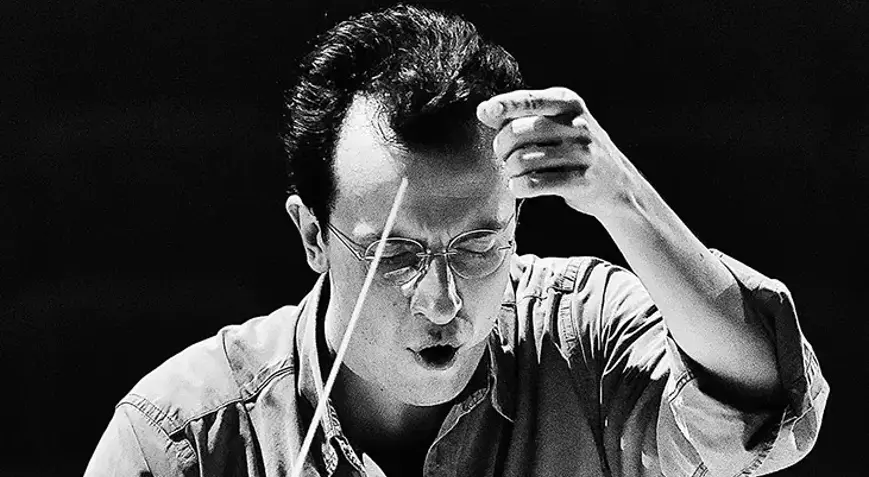
You’ve conducted so many operas and symphonies. Which one has been the most challenging for you, and why?
– Though my repertoire spans a wide symphonic range, opera has been a constant presence in my life — not always at the center of my concert schedule, but never far from my heart. My student years in Vienna were spent almost entirely in the rehearsal rooms and standing sections of the Vienna State Opera. That formation shaped everything. Most recently, I conducted five productions of La Traviata at the Mariinsky Theatre — and Verdi, deceptively simple on the surface, demands an almost surgical precision in shaping the emotional arc across an entire evening. But if I am honest, the works that challenge me most are those I have not yet conducted: Elektra, Salome, and a Wagner production. These are not just ambitions — they are destinations I am moving toward deliberately.
Are there any lesser‑known works or composers you’d like to bring to a wider audience?
– My training was German-language, which means the Austro-German operatic canon is where I feel most at home — not just stylistically, but intellectually. Yet precisely because of that depth, I find myself drawn to works that sit in the shadows of the great repertoire. There are late Romantic and early 20th-century composers whose operatic output deserves far more stage time than it receives. I would rather not name titles here and create expectations — I prefer to let the programming speak when the moment is right.
Our constant question. Could you share some advice with our readers…What opera would you recommend for a first-time opera experience? Which one is best for a romantic date? And what would be a good choice for an evening with a close friend?
– For a first-time opera experience, I would say La Traviata — not because it is easy, but because it is honest. The emotions are immediate, the music is ravishing, and by the end of the second act, you are no longer watching opera; you are inside it.
For a romantic evening, La Bohème. There is a particular cruelty in Puccini’s tenderness that makes the experience unforgettable — you leave the theatre holding each other a little tighter.
For an evening with a close friend — someone with whom you share real conversation — I would choose Don Giovanni. It asks questions neither of you will fully answer, and that is exactly the point.
How confident are you in your orchestra on the day of the performance? For example, are you completely sure that everything will go perfectly, or, on the contrary, do you have doubts about certain musicians — perhaps it’s not their day today? Would this affect your actions, gestures, or emotions during the performance?
– I never walk onto the podium with the assumption that everything will be perfect. That would be complacency, not confidence. What I carry with me is trust — trust built through rehearsal, through shared musical language, through knowing my orchestra. But musicians are human beings, and a performance is a living organism. Yes, I am aware when someone is not quite themselves that evening — a certain tension in the bow arm, a hesitation in the breath before an entry. And yes, that awareness shapes how I conduct: a slightly more deliberate gesture here, more eye contact there, a different quality of presence. The podium is not a place of control — it is a place of response. The best performances I have given were not the ones where nothing went wrong. They were the ones where everything that went slightly wrong became part of something larger and alive.